


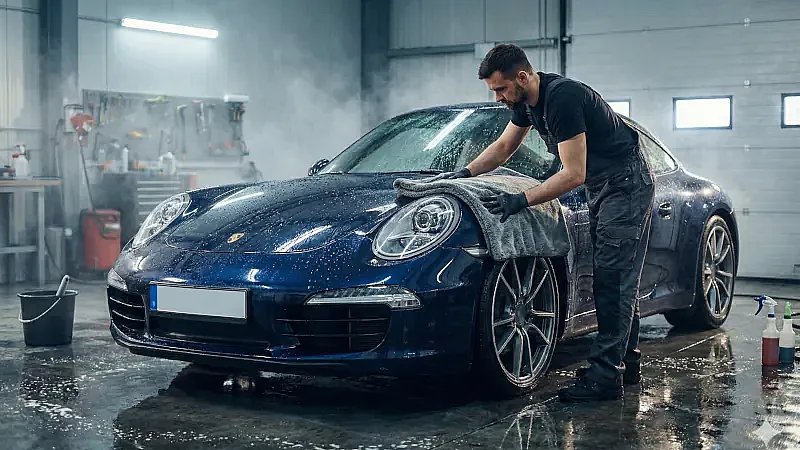
Chemical Decontamination of Car Paint – Removing Tar, Iron Fallout and Industrial Deposits
Tar, glue, iron fallout and industrial deposits are among the most stubborn contaminants found on car paint. Regular washing is not enough – these contaminants are embedded in the clear coat and require specialised chemical products to dissolve. Chemical decontamination is a critical step between washing and polishing that professional detailers never skip.
In this guide we cover how to use tar remover, iron fallout remover (deironizer) and clay bar step by step – the correct order, proper technique and common mistakes to avoid.
Why is chemical decontamination necessary?
After a thorough wash with snow foam and car shampoo, the paint may look clean – but it is rarely completely free of contaminants. If you run your hand across a freshly washed panel and the surface feels rough or gritty, there are still particles embedded in the clear coat. These must be removed before polishing or applying wax, ceramic coating or paint protection film (PPF). Otherwise you risk dragging contaminants across the paint during polishing, causing new scratches.
Essential products and accessories
- Tar & Glue Remover
- Deironizer (iron fallout remover)
- Clay Bar or Clay Mitt
- Clay lubricant or car shampoo diluted in water
- Microfibre cloths
- Container with lukewarm water
Step 1: Tar and glue removal
Tar & Glue Remover is designed to be applied to dry paint. Spray the product across the entire vehicle – focus on lower panels, bumpers, sills and behind the wheel arches where tar build-up is heaviest.
How to do it:
- Make sure the paint is clean after washing but dry.
- Spray the tar remover evenly across the surface.
- Allow 3–5 minutes of dwell time (follow the manufacturer's instructions).
- Wipe away dissolved tar with a microfibre cloth.
- Rinse thoroughly with a pressure washer.
Step 2: Iron fallout and metal particle removal
Iron fallout remover (deironizer) dissolves embedded iron particles from brake dust, rail dust and industrial fallout. The product can be applied to both wet and dry paint – the choice depends on personal preference and the level of contamination.
How to do it:
- Spray the iron fallout remover evenly across the panels.
- Allow 2–5 minutes of dwell time – the product changes colour (typically purple/red) as it reacts with iron particles.
- Rinse thoroughly with a pressure washer.
Step 3: Mechanical cleaning with clay bar
After chemical decontamination there may still be embedded contaminants such as tree sap, limescite deposits and industrial dust that require mechanical removal. This is where a clay bar or clay mitt comes in.
How to do it:
- Work one panel at a time.
- Spray plenty of clay lubricant or diluted car shampoo onto the surface – the clay must never glide on dry paint.
- Move the clay back and forth with light pressure in straight strokes.
- You can clearly feel and hear when the clay picks up contaminants – the surface becomes progressively smoother.
- Knead the clay regularly so that a clean surface is always in contact with the paint.
- Wipe off with a clean microfibre cloth.
The correct order: chemical before mechanical decontamination
It is important to always carry out the steps in the correct order:
- Wash – remove loose dirt with snow foam and car shampoo.
- Tar removal – dissolves organic contaminants (tar, glue, tree sap).
- Iron fallout removal – dissolves metallic contaminants (brake dust, iron oxides).
- Intermediate wash – quick wash to remove chemical residue.
- Clay bar / clay mitt – mechanical removal of remaining embedded particles.
- Polishing, waxing or ceramic coating – the paint is now fully prepared.
Skipping the chemical stage and going straight to the clay bar risks dragging tar and metal particles across the paint, causing scratches.
Suitable for: Professional detailers, reconditioning technicians, paint protection specialists (PPF and ceramic), car mechanics and car enthusiasts preparing paint for polishing.
Industries: Vehicle care, car reconditioning, detailing studios, car dealerships, paint protection installation and fleet management.
Frequently Asked Questions About Chemical Decontamination of Car Paint (FAQ)
Can you use tar remover and iron fallout remover on wet paint?
Tar remover (Tar & Glue Remover) should be applied to dry paint for the best effect – water dilutes the product and reduces its dissolving power. Iron fallout remover (deironizer), on the other hand, can be applied to both wet and dry paint. Many detailers prefer to use deironizer on wet paint straight after rinsing, as the product spreads more easily. Regardless of the method, never allow the products to dry on the surface.
How do you know if the paint needs decontamination with a clay bar?
Use the plastic bag test: place a thin plastic bag over your hand and run it gently across a freshly washed panel. Through the plastic, irregularities and embedded particles are felt more clearly than with bare fingertips. If the surface feels gritty or rough despite the car being freshly washed, it needs decontamination. Check horizontal surfaces such as the bonnet, roof and boot lid in particular – these collect the most fallout.
In what order should tar remover, iron fallout remover and clay bar be used?
The order is: 1) tar remover on dry paint, 2) iron fallout remover, 3) quick intermediate wash with shampoo, 4) clay bar with clay lubricant. Chemical decontamination must always be carried out before mechanical (clay bar). The tar remover dissolves organic contaminants and the iron fallout remover dissolves metal particles – this reduces the amount of contamination the clay needs to remove and lowers the risk of clay-induced marring.
Leave a comment