


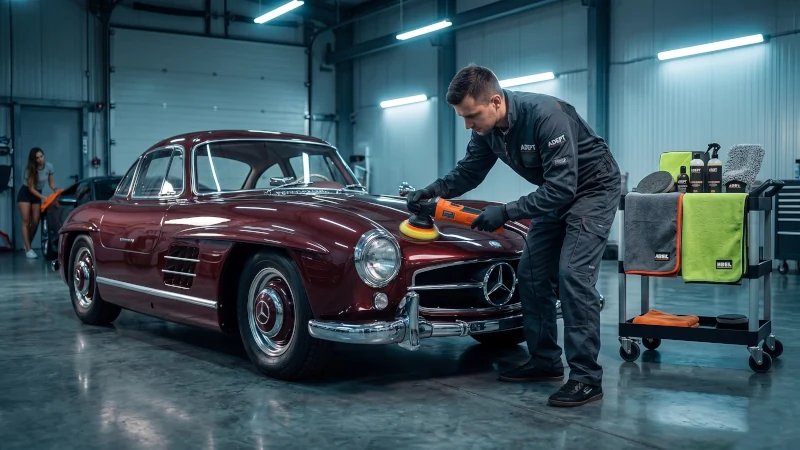
Every car enthusiast dreams of owning a well-maintained car with paint that shines beautifully. One of the most important steps to get there is paint correction, where you remove defects and create a perfect surface. As a beginner, you often face a dilemma – which polishing machine should you choose for safe, effective, and easy use? In this guide, we go through what to look for and our recommended models.
Key Points
- Dual Action (DA) is safest for beginners – reduces risk of paint damage
- 500-900 W motor is optimal for beginners
- 8-15 mm stroke gives a good balance between power and control
- Weight 2-3 kg – lighter machine makes work easier
- 125 mm backing plate is the most versatile size
Different Types of Polishing Machines – What to Choose?
There are three main types of polishing machines on the market, and each has its strengths and weaknesses. Understand the difference before you choose.
Rotary Machines
Rotary polishers offer high power and effectiveness, but require focus and experience. Improper use can lead to permanent paint damage because the pad spins in a constant circle that easily generates heat. These are not recommended for beginners.
Dual Action (DA) Machines
Dual Action machines are more beginner-friendly because their oscillating motion reduces the risk of holograms (circular patterns in the paint) and surface overheating. The pad rotates both around its own axis and in an oval pattern, spreading heat more evenly. Read more about how Dual Action polishers work.
Planetary Machines
Planetary machines are technically more advanced and combine the advantages of both DA and rotary machines. They allow effective scratch removal and top-level paint results. The price is higher, however, and the learning curve steeper.
Our advice for beginners: Choose a Dual Action (DA) machine. It's safe, comfortable to use, and minimizes the risk of paint damage. You can always upgrade later when you've gained experience.
Important Features for a Beginner Polishing Machine
When comparing different models, focus on these four features. They affect both the result and your comfort during work.
Motor Power
Optimally between 500 and 900 W. Too weak a motor struggles with thicker compounds, while too strong a motor becomes heavy and hard to control for a beginner.
Oscillation Stroke
For beginners, a stroke between 8 and 15 mm is recommended. Shorter strokes give more control but less power. Longer strokes remove deeper scratches but require more experience.
Weight and Ergonomics
Lighter machines between 2 and 3 kg make work significantly easier. You'll be holding the machine for perhaps 1-2 hours at a time – every extra 100 grams is felt in your arms.
Backing Plate Size
The most versatile size is 125 mm. For hard-to-reach surfaces (bumpers, door handles), 75 mm is also useful. Many models come with both sizes in the package.
Recommended Polishing Machines for Beginners
Here are the models we recommend if you're starting with polishing. All are Dual Action machines and meet the criteria above. You'll find them all in our range of polishing machines.
Monster Shine x ADBL Roller D09 ATOM
Compact Dual Action machine with 9 mm stroke, perfect for precision work even in hard-to-reach areas. Balanced power, ergonomic design, and Soft Start system provide comfort and safe use. With two backing plates (75 mm and 125 mm), it's incredibly versatile. Strong 650 W motor and 8-meter cord enable long working sessions without limitations.
See ADBL Roller D09 ATOM at HQLights
ADBL Roller D09125-02
Compact Dual Action with 9 mm stroke, excellent for hard-to-reach surfaces like bumpers and aerodynamic details. Equipped with 750 W motor, speed stabilization, and Soft Start. Comes with 125 mm and 75 mm backing plates, wrench, carbon brushes, and a practical storage bag. ADBL is a well-known Polish detailing brand with long experience in professional car care.
See ADBL Roller D09125-02 at HQLights
ADBL Roller D15125-01
Dual Action machine with 15 mm stroke providing optimal power for removing scratches and creating a perfect finish. Equipped with 810 W motor, enabling intensive paint refreshing in a single step. Electronically controlled Soft Start system and speed stabilization provide comfort and safe use. The package includes transport bag, 125 mm backing plate, side handle, wrench, carbon brushes, and silicone grease.
See ADBL Roller D15125-01 at HQLights
EVOXA HDF8
Compact Dual Action machine with 8 mm stroke, a solid choice for detailing enthusiasts. Equipped with 850 W motor and NSK bearings for reliability and top efficiency. Comes with interchangeable 75 mm and 125 mm backing plates. Flexible 5-meter cable and ergonomic construction provide high working comfort. Covered by a 24-month warranty with extension option.
ShineMate EX610-5/15
Professional Dual Action machine with 15 mm stroke, designed for the auto detailing industry. Equipped with speed control (2000-4500 RPM) with stabilization and soft start for high precision and comfort. Innovative Dust-Devil™ backing plate at 123 mm lowers pad temperature and extends its lifespan. Ergonomic design and 5-meter cord make the machine practical for long sessions. ShineMate is an established Asian manufacturer of professional polishing machines.
See ShineMate EX610-5/15 at HQLights
ShineMate ERO600
Dual Action machine with 9 mm stroke, suitable for both beginners and experienced detailers. Equipped with 600 W motor and speed control from 2500 to 6800 RPM for efficient and precise work. Light construction (2.0 kg) and ergonomic design increase user comfort. Comes with 123 mm backing plate – an excellent solution for single-stage paint refreshing.
See ShineMate ERO600 at HQLights
What Else You Need Besides the Machine
The machine alone isn't enough – you also need the right accessories for good results. Think of this as a complete system where every part affects the final result.
- Polishing pads in different hardness (cutting, polishing, finishing)
- Polishing compounds with different abrasiveness
- Microfiber cloths for cleaning between steps
- Isopropanol (IPA) for degreasing
- Masking tape to protect rubber trim and plastic details
Frequently Asked Questions About Polishing Machines for Beginners
Is it hard to learn polishing?
With a Dual Action machine, it's surprisingly easy to get started. Plan for a few hours of practice on an old panel or a less visible part of the car before tackling the main areas.
How long does a polish last?
Depending on the paint condition and what finish you apply afterwards – often 6-12 months. With a ceramic coating, you can extend the effect to several years.
Can I damage the paint with a DA machine?
The risk is very low compared to rotary machines. The biggest risk is polishing through the clear coat if you work too long in one spot – always keep the machine moving.
What's the difference between 8, 9, and 15 mm stroke?
Longer stroke (15 mm) provides more cutting power and removes deeper scratches faster, but requires more experience. Shorter stroke (8-9 mm) gives more control and is perfect for hard-to-reach areas.
Do I need an expensive machine for good results?
No. A mid-range machine in the €200-400 range is plenty for 99% of beginner needs. Technique and accessories have the biggest impact on the final result.
Can I use the same machine on rims and plastic?
Yes, but switch pad and possibly compound depending on the surface. For rims there are dedicated wheel pads in smaller sizes.
Summary
Choosing your first polishing machine doesn't have to be hard. For beginners, the Dual Action machine is the obvious choice – it provides safety in work and excellent polishing results. Remember that the machine itself isn't everything – the right pads and compounds are equally important.
- Choose Dual Action (DA) as your first machine
- 500-900 W motor and 8-15 mm stroke is optimal
- 125 mm backing plate is most versatile
- Invest in good polishing pads and compounds too
- Practice on a less visible part of the car first
Ready to start polishing?
See our range of polishing machines at HQLights
Or see our selection of polishing pads and polishing compounds.
Last updated: April 25, 2026
Leave a comment